On September 15, 2011, beginning at 12:48:54.600, we witnessed a time warp: trade
executions occurred up to 190 milliseconds in time before their corresponding
quotations. It all happened in just over one second, the evidence buried under an
avalanche of about 19,000 quotations and 3,000 individual trade executions. This surge
was not enough to plug up the UQDF/UTDF data feeds that transmit this information
to traders, mostly because there was little activity in other stocks at that time.
At least it appeared that way, because looking at those feeds in detail (both the
overall feed and the individual multicast line # 6) show they have carried far more
data at other times -- but probably not concentrated in just one symbol.
All exchanges and trade reporting facilities were sending trades ahead of quotations, except for the
Nasdaq Trade Reporting Facility (NTRF) which appeared to be transmitting some
trades in sync with the lagging quotations -- more on that shortly. Right before
and after this event, quotes and trades in YHOO had exchange timestamps with the same
time: they were properly synchronized.
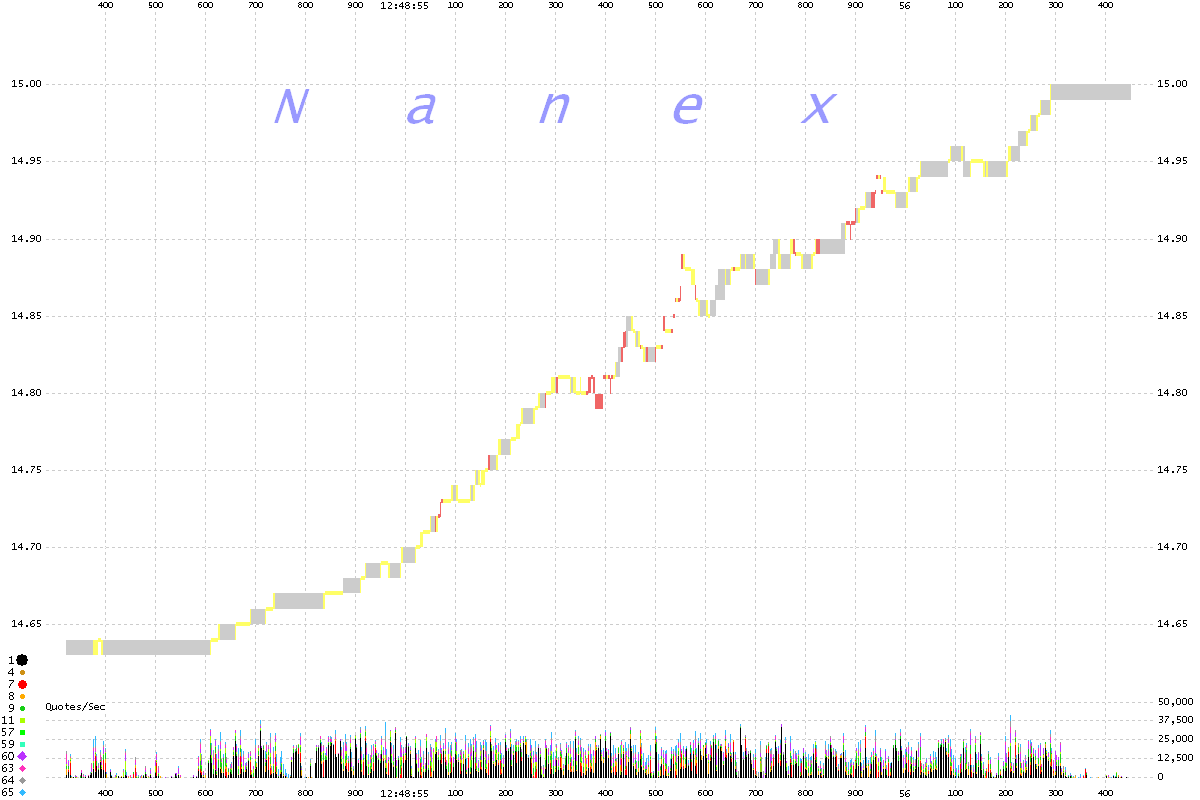
The first chart is a 250 ms interval chart of the NBBO in YHOO which is plotted as vertical
lines and colored red if the NBBO was crossed during the interval, yellow if it was
locked, and gray if it was normal. The implied quote rate is shown as a histogram
at the bottom -- and scaled in quotes/second. We will focus on the time shown in the black circle.
|

The next chart shows the area encircled above in detailed 2 millisecond intervals.
|
The next chart includes trade executions, which are plotted as dots or squares and are sized according to trade size. Each
reporting exchange uses a unique color and shape. An exchange code table appears at
the end of this page. NTRF is shown as light green squares. What is unusual about this chart is that trades are reported ahead
of quotes. The dots/squares should trail after the quotes.
|

We can see the delay more clearly if we isolate two of the more active exchanges,
in this case, Nasdaq (1, black) and NYSE/ARCA (7,red). The bid/ask spread is plotted
as vertical bars -- black for Nasdaq, red for NYSE/ARCA. You can clearly see that
the bid/ask spread has the same shape as the trades, except it is offset to the right.
The quotes should always come before, or to the left of the trades. The offset is
the minimum extent of the delay.
|

If we plot quotes and trades from just one of the active exchanges on a 1 millisecond
interval chart, we can easily measure how far in time the trade messages came before
the quotes and therefore estimate the minimum amount of time the quotes were delayed.
|

So how can a trade execution occur before the quote it executed against? Unless a
worm hole opened up on Wall Street, it can't. We think the quotes became delayed.
But how can someone execute against an old quote? They can't. 19,000 quotes
and 3,000 trades didn't come from humans. This is the work of a HFT computers hooked
directly into the exchanges. Though the timestamps placed on these quotes don't show
it, the data storm spewed out by HFT had to plug up the data somewhere.
Regulation NMS is pretty clear that direct exchange feeds are prohibited from sending
quote and trade data to recipients ahead of the SIP (UQDF/UTDF) -- which computes
the NBBO after all.
This raises a few thorny questions.
How does one ensure trade-through price protection if the price being protected
hasn't even occurred yet? Are the timestamps being altered to hide delays? Because
this event was isolated to one stock, it wasn't enough to overwhelm the feed, yet
there is clearly a significant delay. Does this mean there are far more delays than
we previously though? Is there a delay every time we see an explosion of quotes in
one stock? Because that sort of thing happens. All. The. Time.
There is something else interesting about this event. As mentioned earlier, some
of the
trades reported through NTRF had prices/timestamps that aligned with trades from
other venues, but the other trades had prices/timestamps that aligned with the delayed
quotes. Same timestamp. Reported in sequence with the other trades. Very few trades, if any, were in between. It could be that some of these trades were reported late and the lateness coincidentally matched the delay in the quotes. However, we did find that the cumulative size
for the NTRF delayed trades was
very close to the cumulative size of the non-delayed
trades. It would be interesting to know if the
same firm was a party to both the delayed and non-delayed transactions in NTRF. Though,
this is something only a regulator could find out.
What if you were an internalizer -- someone that matches customer orders internally
instead of sending them to an exchange for execution. Internalizers execute trades
based on prices from the SIP, which in this case, is UQDF. What if you knew the extent
of the quote delay within UQDF? You could sell stock at the "real" quote using a direct non-delayed
feed, and buy stock from the internalized order flow at the lower, UQDF
reference price and capture the difference.
Below is a 1 millisecond interval chart showing trades from Nasdaq (black dots) and
NTRF (green squares) along with the NBBO. Circle 1 is the time immediately preceding
the event when everything was synchronized. Circle 2 shows NTRF trades that line up
with trades from Nasdaq (and all other markets). Circle 3 shows NTRF trades that line
up with the delayed quotes.
|

The chart below shows quote message rates for UQDF and multicast line #6 which is
the line that carries YHOO quotes. The time of the event is shown at the lower left.
Although traffic from YHOO was a significant percentage of all traffic on UQDF, it
was still not high enough to indicate any problems. Note that the surge on the right
side of the chart is much higher.
|

Exchange Code Legend:
| 1 |
NQEX |
Nasdaq Exchange |
| 4 |
AMEX |
American Stock Exchange |
| 7 |
PACF |
NYSE ARCA |
| 8 |
CINC |
National Stock Exchange |
| 9 |
PHIL |
Philidelphia Stock Exchange |
| 11 |
BOST |
Boston Stock/Options Exchange |
| 57 |
NQNX |
NSX Trade Reporting Facility |
| 59 |
NTRF |
NYSE Trade Reporting Facility |
| 60 |
BATS |
BATS Trading |
| 63 |
BATY |
BATS Y Exchange |
| 64 |
EDGE |
Direct Edge A |
| 65 |
EDGX |
Direct Edge X |
|
Inquiries: pr@nanex.net
Publication Date: 09/15/2011
http://www.nanex.net
| This report and all material shown on this
website is published by Nanex, LLC and may not be reproduced, disseminated, or
distributed, in part or in whole, by any means, outside of the recipient's
organization without express written authorization from Nanex. It is a
violation of federal copyright law to reproduce all or part of this publication
or its contents by any means. This material does not constitute a solicitation
for the purchase or sale of any securities or investments. The opinions
expressed herein are based on publicly available information and are considered
reliable. However, Nanex makes NO WARRANTIES OR REPRESENTATIONS OF ANY SORT
with respect to this report. Any person using this material does so solely at
their own risk and Nanex and/or its employees shall be under no liability
whatsoever in any respect thereof. |
|
|
|

